

"It has been incredibly rewarding to play a role in shaping the future of The Graduate School,” says Dr. Sarah Freed, WCU’s interim vice president for enrollment management who currently also serves the Pennsylvania State System of Higher Education as senior advisor to the chancellor for enrollment management.
“Pursuing graduate education is a very intentional decision. Many of our students are balancing careers, families, and other responsibilities while investing in themselves. As a working professional and mother who returned to complete my doctorate, I have experienced firsthand the challenges and determination that come with that journey, and that perspective shapes how I approach this work every day.”
Dr. Freed says WCU’s Graduate School “stands out for its commitment to career-relevant programs, personalized support, and engaged faculty with real-world experience.
“As we continue to expand graduate scholarships, streamline admissions, offer additional flexible program options and enhance student services, we are creating an environment where graduate students can advance their education while feeling supported every step of the way.”
That personal attention is part of the culture at all of WCU’s locations: main campus, the Graduate Center, and WCU in Philadelphia as well as online. The Philadelphia Center, which marked the 10th cohort of graduate students in 2025, currently offers the master of social work (MSW).
Jayelah Hayes, one of three co-presidents of the Graduate Student Association (GSA), is on track to complete her MSW this May. She attests, “As a student primarily based at the Philadelphia location, I have received a great deal of support from both my professors and onsite staff. They consistently made themselves accessible and were willing to help — even if it meant finding answers after the fact. That level of commitment made a meaningful difference in my experience.”
Benjamin Morgan M’23 is associate director of the Student Success Center at WCU in Philadelphia. He earned his MSW there and has been “a part of the WCU team in Philly since 2015, first as a graduate assistant with the Writing Center, then as a full-time staff member coordinating student support services” for both graduate and undergraduate clients. “Higher education has changed so much in the last 10 years, and it’s been rewarding for me in my student support role to see how our University has responded to these changes, especially in how we support graduate students,” says Morgan.
“The University has worked hard to develop more hybrid and remote learning programs, and the Philly Center, which serves mostly professionals who are part-time students, now offers a powerfully flexible experience,” he continues. “We work hard to ensure access to the same institutional supports [and recognize] that many of our graduate students choose our center for a streamlined path to the credential and a location that keeps them closer to family, work, and opportunities in Philadelphia.”
“Being able to expand access and create a more supportive, flexible experience for students is both meaningful and motivating,” says Dr. Freed. “It is especially rewarding to know that the work we are doing has a direct impact on our students’ ability to achieve their goals.”

SUPPORT AND COMMUNITY
Collaborations with campus partners enable the Graduate School to provide graduate students with seamless support.
“Cross-campus partnerships are critical to graduate student success,” says Dr. Freed. “When all areas of campus are working together, we’re able to support students throughout their entire graduate experience. These partnerships help remove barriers, simplify processes, and more clearly communicate the value of a graduate degree.”

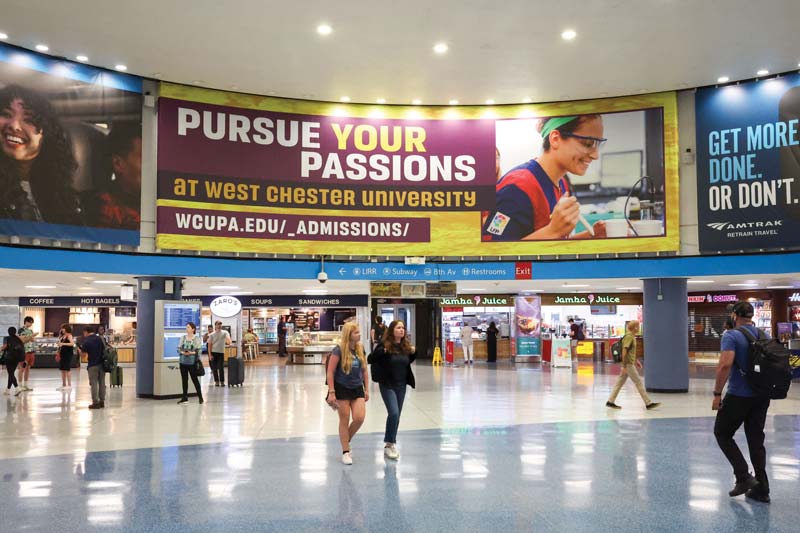
WCU advertising dominates Penn Station in New York City.
Among those partnerships: The Career Development Center hosts a graduate-specific website and works individually with programs to address the needs of graduate students. The library has a graduate- only lounge, a graduate-only resource webpage, and librarians who specialize in assisting graduate students in specific disciplines. New this year at the Writing Center: Doctoral students as writing tutors who are responsive to the need of other doctoral students.
Robust support can also be found in program-specific student professional organizations, each with a faculty advisor, that are specifically for graduate students, among them Industrial Organizational (I/O) Psychology Graduate Club, WCU PA (Physicians Assistant) Student Society, MBA Professional Development Group, American Statistical Association, Gerontology Interest Group, and WCU Human Resource Association (HRA).
Both tangible and intangible returns on investment demonstrate the overall value of an advanced degree.
Dr. Reva Zimmerman, assistant professor and graduate coordinator for speech-language pathology, says, “As graduate educators, we create communities of thoughtful, well-rounded individuals who have expertise, and those communities persist well past graduation.”
Adds Morgan, “As a luxury of our size [in Philly], our smaller community encourages more meaningful, personal connections among graduate students that are leveraged beyond the classroom. Our largest program, social work, is intentional in building these connections through experiential and community-engaged learning.”
FLEXIBILITY FOR THE ADULT LEARNER
WCU’s current graduate enrollment is 2,743 students including those enrolled at the Philadelphia site.
“WCU graduate students come from a wide range of backgrounds,” notes Dr. Freed. “Some have recently completed their undergraduate degree, while others are working professionals looking to advance or change careers, or adult learners returning to school for personal and professional growth. Many are balancing multiple responsibilities while pursuing their degree. At West Chester, they can expect a supportive, flexible experience with programs designed to fit into their lives, along with expert faculty who bring real-world experience into the classroom.
"A diverse graduate student body enriches the learning experience and the University as a whole,” she continues. “When students bring different perspectives and experiences, it strengthens discussion, deepens learning, and creates a stronger overall student experience.”
These individuals are not only looking to increase their earning potential and expand their skills. They are pursuing passions. They want to earn their degrees when it fits into their schedules with work and family; in person, online, or in a hybrid delivery format; and affordably.
A diverse graduate student body enriches the learning experience and the University as a whole.
- Sarah Freed, Interim Vice President for Enrollment Management
With more than 120 doctoral, master’s, certificate, certification, and accelerated programs, WCU supports those students in achieving their academic and professional goals, and attaining personal enrichment.
“What initially drew me to WCU [in Philadelphia] was the combination of location, flexible course options, affordability, and strong degree track offerings,” notes MSW candidate Jayelah Hayes. “The ability to complete my degree while working full time was the deciding factor. It gave me the confidence and flexibility I needed to take the next step in my academic journey.”
BY THE NUMBERS
2,743
GRADUATE ENROLLMENT (FALL 2025)
120
DOCTORAL, MASTER’S, CERTIFICATE, CERTIFICATION, AND ACCELERATED PROGRAMS
380
STUDENTS ARE GRADUATE ASSISTANTS
WCU’S GRADUATE SCHOOL OFFERS FLEXIBLE PROGRAMS THROUGH:
- Delivery modes that include accelerated bachelor’s to master’s programs for savings in tuition and time-to-degree; in person, online, and hybrid formats; flexible timeframes (shorter semesters and varied start times for some programs). These programs, for example, are offered in seven-week terms: MBA, master of science in human resource management, certificate in advanced educational leadership (letter of eligibility for superintendency), certificate in human resource management.
- Program types: certificates (nearly all of which are offered online) as well as master’s and four doctoral degrees. Two doctoral programs, the doctor of public administration and the doctor of nursing practice, are offered 100% online.
"We are working very closely with programs to see how we can become even more flexible in an effort to reach students where they are, and to ensure WCU graduate education remains competitive in today’s changing landscape,” says Alana Luttermoser, executive director of graduate admissions.
For instance, this fall, the master of arts in communication studies will transition to an all-online format, including most electives, “balancing synchronous and asynchronous offerings,” explains Dr. Adam Rainear, associate professor and graduate coordinator for communication and media.
“Many of our modern topics courses were being offered online but some of our core requirements were still being held in person. … Now our program will have significant flexibility in what we offer students, alongside being the best value in the area. … This appeals to traditional master’s students who might be working outside of school, but it also has appealed to our accelerated (4+1) program students. Since most of them are juniors or seniors, being able to take a graduate class in an online format frees up their schedule for extracurriculars, work, and studying.”
EXPERIENTIAL OPPORTUNITIES
The graduate experience at WCU offers multiple engagement opportunities for students: conducting research for theses and dissertations, attending in-person and virtual conferences, presenting to on- and off-campus organizations; completing internships, student teaching, practica, and health care rotations.
Nearly 400 graduate students are graduate assistants (GAs) conducting research with faculty, supporting students, and contributing to both campus and community.
Experiential learning is infused in WCU’s graduate school experience. One of many examples: Graduate students in the master of psychology in industrial and organizational science work with community organizations in consulting classes.
Dr. Zimmerman adds, “Graduate students are not just trainees, but contributors: to research, clinical practice, and their communities.”
VALUE
“WCU’s tuition remains competitive,” says Dr. Freed. “However, even with lower tuition rates, students are still seeking financial assistance to fund their graduate education. In response, WCU has begun investing institutional aid in graduate students. For example, in fall 2025, we launched our first graduate merit scholarship program targeting the master’s in human resource management and the master’s in nursing. We are currently working to expand this investment so we can reach and support more graduate students.”
The Graduate School offers the Graduate Dean’s Professional Development Award, which provides funding to current graduate students to reimburse registration fees for conferences that are beneficial to professional development and degree advancement. The Graduate Student Association and Graduate Council Awards for Excellence recognize graduating master’s and doctoral students who excel in three areas: leadership, service, and/or advocacy; practice; and scholarship and/or creative activity.
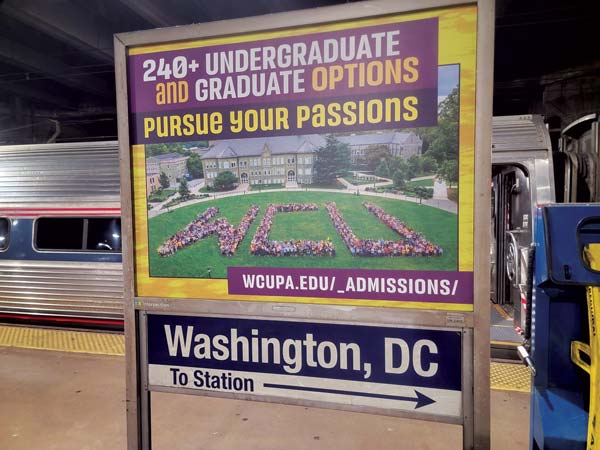
Graduate ads catch the attention of commuters in Union Station, Washington, D.C.

What’s New in GRADUATE EDUCATION @WCU
Master’s in Elementary Education with Early Grades Teacher Certification
This program addresses the nationwide teacher shortage while meeting prospective students’ needs whether they have experience in education or in other fields. The master of education is a 45-credit hybrid program with in-person field placements and a full semester of student teaching. The first cohort will enroll in fall 2026.
TESOL
The master of arts in Teaching English to Speakers of Other Languages (TESOL) and the Teaching English as a Second Language (TESL) specialist certificate programs are now 100% online. The 18-credit certificate is fully embedded within the 30-credit master’s program and can be completed as a standalone credential or en route to the degree. Undergraduates with 60 completed credits pursuing bachelor’s degrees in early grades preparation (PreK-4) or English education may apply to the accelerated bachelor’s to master’s with ESL specialist certificate.
Wells Summer Music Institute
The Wells Summer Music Institute provides pathways for music educators to enhance their skills and advance their professional development through immersive summer courses and workshops. Academic courses and specialized seminars led by nationally recognized leaders in music education are offered in a variety of modalities with three pricing options. All courses meet NASM accreditation standards and fulfill requirements for teacher certification renewal and professional growth programs.
Three-Minute Thesis Competition
WCU’s Graduate School partnered with the Office of Research and Sponsored Programs for the inaugural Three-Minute Thesis Competition (3MT), an international initiative hosted in the U.S. and Canada by the Council of Graduate Schools. As a pilot, this year’s competition was open only to WCU doctoral students, who presented their dissertation or thesis in three minutes to a non-specialist audience. 3MT cultivates graduate students’ academic, presentation, and research communication skills.
Coming Soon
Beginning next academic year, WCU will offer new graduate certificates in artificial intelligence engineering, cloud engineering, and law enforcement leadership. In addition, the MBA curriculum has been updated to incorporate a new business analytics course and artificial intelligence concepts, tools, and ethical considerations across the curriculum.