
Restorative Action Plan and Areas of Concern
Educator Preparation Programs
Updated: July 18, 2024
Restorative Practices
During their educator preparation program, Teacher Candidates learn about professional teacher expectations through the Model Code of Ethics for Educators, the Pennsylvania Code of Professional Practice for Conduct for Educators (Code Chapter 235) and the Professional Educator Discipline Act (Code Chapter 237). If a Candidate does not meet professional expectations, a Faculty or a Staff member fills out a concern form indicating Level 1 or 2 in one of the following restorative practices areas:
The Model Code of Ethics for Educators (MCEE)
(MODEL CODE OF ETHICS FOR EDUCATORS (MCEE) or Appendix)
Principle I: Responsibility to the Profession
Principle II: Responsibility for Professional Competence:
Principle III: Responsibility to Students
Principle IV: Responsibility to the School Community
Principle V: Responsible and Ethical Use of Technology
The Faculty member or Department/Program chair will meet with the Candidate to discuss the concern and make a “Restorative Action Plan” which will include specific, measurable tasks, outcomes, and deadlines, as well as consequences if the plan is not completed successfully. Restorative action plans help the Candidate reflect on the Model Code of Ethics for Educators and develop their ability to make strong decisions.
Level 1 (Minor Concern)
A Faculty or Staff member submits a concern about a Candidate by completing the “Concern Form” via Qualtrics. A Mentor Teacher can raise a concern about a Candidate by contacting the Candidate’s University Faculty Supervisor who will complete the concern form. The level of concern (Level 1 or 2) must be indicated before submission. While most concerns are at a Level 1, a faculty member may choose to escalate the concern to a Level 2 concern if there is more than one concern happening at the same time or if the concern is a more serious concern in the field or classroom but doesn’t violate Chapter 235 or 237. Next, the faculty member conferences privately with the Candidate to complete the “Restorative Action Plan.” Failure to successfully complete the “Restorative Action Plan” may also escalate the concern to a Level 2. Candidates may appeal Level 1 decisions within five business days via email to the Department Chair. The Department Chair’s decision is final in this appeal. All parties must sign the form and a copy will be emailed to the Candidate.
Level 2 (Moderate Concern)
A concern is Level 2 when there have been at least two Level 1 concerns submitted, the Level 1 “Restorative Action Plan” was not successfully completed, or Level 2 was indicated on the initial concern. If the concern is a Candidate’s first and designated a Level 2, the Department Chairperson or Program Coordinator can discuss the level of the concern with the faculty member to decide if it should remain at a Level 2 or be lowered to Level 1. There are two ways that a Level 2 concern can be elevated to a Level 3 concern. First, the Department Chairperson or Program Coordinator can immediately elevate the concern to Level 3 if there are at least two Level 2 concerns. Next, the Department Chairperson, Program Coordinator, Associate Dean, and/or the Departmental committee conference with the Candidate. They complete the Page 3“Restorative Action Plan” and assign a due date for the Candidate to submit any items. All parties must sign the form and a copy will be emailed to the Candidate. The second way that a Level 2 concern can be elevated to a Level 3 concern is if the Candidate does not successfully complete the action plan, then the concern moves to Level 3. Candidates may appeal Level 2 decisions within five business days to the Associate Dean via email and the Associate Dean’s decision is final.
Level 3 (Transition to Significant Concern)
Concern is referred to the EPP Review Board as an area of significant concern by the Department Chair or Associate Dean.
Restorative Practices Summary Chart
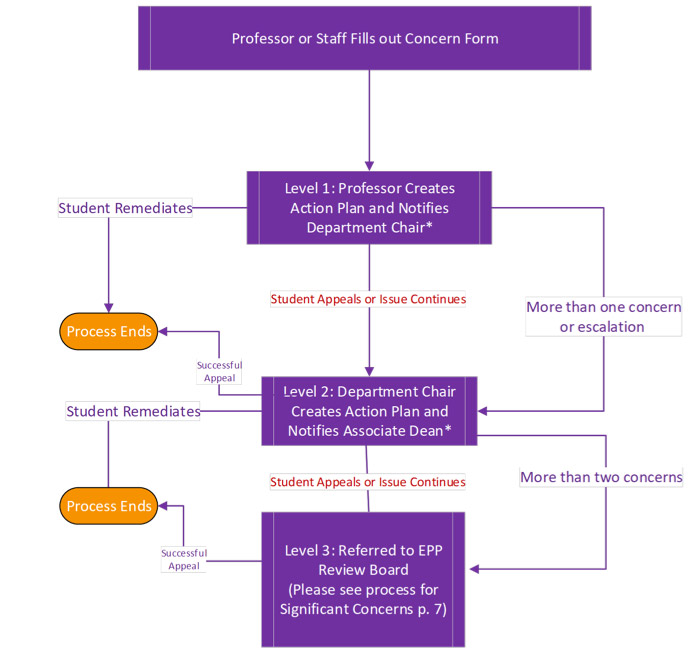
*Candidates can appeal the decision of any level to the next level via email within five business days of the decision. The Decision at the next level is final.
**This chart does not involve violations of Chapter 235 or Chapter 237.
Areas of Significant Concern (Level 3)
Areas of significant concern can arise at any time during a teacher Candidate’s preparation program: courses, clinical experiences, or student teaching. There are three ways a concern can be labeled a significant concern.
First, a Faculty member, Department Chair, or Associate Dean can submit a significant concern form if there is a violation Pennsylvania Code of Professional Practice or Conduct for Educators (Code Chapter 235) and/or the Professional Educator Discipline Act (Code Chapter 237):
Code of Professional Practice and Conduct for Educators Chapter 235
§ 235.5a. Commitment to students.
§ 235.5b. Commitment to colleagues.
§ 235.5c. Commitment to the profession.
The Professional Educator Discipline Act Chapter 237.3-237.9
237.3. Immorality
237.4. Incompetency.
237.5. Intemperance
237.7. Cruelty
237.8. Negligence
237.9. Crimes involving moral turpitude
A second way concerns become a Significant Concern (Level 3) is when a school (mentor teacher, school administrator, or school human resources representative) dismisses a Candidate from their placement. The Candidate must leave the school and immediately report to their University Supervisor that they have been asked not to return. WCU’s EPPs also have the right to remove a Candidate from their assigned placement if there is a violation of Chapter 235 or Chapter 237. If an area of concern (by either the school district or university personnel) results in removal of the Candidate from the placement, including student teaching, the Candidate shall not return to their placement nor shall the Candidate be assigned to another placement, until the EPP Review Board’s investigative process is completed.
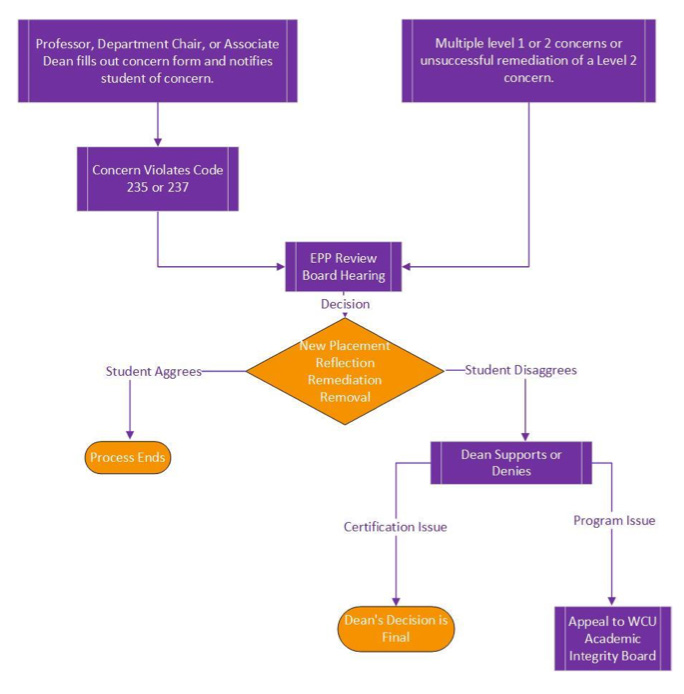
A third way a concern can become significant is when a Candidate has multiple Level 1 or 2 concerns or if restorative practices (action plans) in Level 2 have been unsuccessful.
Significant concerns require a hearing with the EPP Review Board and can lead to denial of recommendation for certification and/or dismissal from the program.
The Associate Dean reviews all Level 3 Concern submissions to assure that one of the following is true:
- The Concern has been elevated due to the number of previous concerns or failure to complete an action plan.
- The Candidate was removed from field experience or student teaching.
- The Candidate has violated one or both of Chapter 235 or Chapter 237.
If there is no evidence of any of these three conditions, the Associate Dean will roll the concern back to a Level 2: Department Chair level. The submitter of the concern may appeal the Associate Dean’s decision and advance the concern to the Dean. The Dean’s decision is final.
Procedure (emailed to student prior to the meeting)
Once a significant concern is filed, the EPP Review Board will hold a hearing within
10 business days. The EPP Review Board will be led by the CESW Associate Dean and
include the University Supervisor or Department Chairperson (faculty member), one
member from the CESW Field Experience Committee (faculty/staff member), and one member
of the CESW Dispositions Committee from a department other than the Candidate’s program
(faculty member). The Candidate may have the WCU Ombudsman, a WCU faculty member in
Educator Preparation Programs, or a WCU Student Success Coordinator present to support
them as a non-voting attendee. This individual may consult with the Candidate during
the meeting but may not address the Board directly.
During the hearing, the Board will hear testimony and review evidence from the Candidate and all participants involved.
- Formal rules of evidence will not be employed.
- The Board will give appropriate weight to evidence, based on its reliability.
- The Board will not make a decision to deny a recommendation for certification or to dismiss a Candidate from the program based solely on hearsay evidence.
After receiving all the evidence, the Board will recommend one of the following (or possibly a combination new placement and remediation). In the case of a tied vote, both options will be offered for the Candidate to choose their preference:
- New Placement: In this instance, an effort to find a new placement will be made. It is not guaranteed that a new placement will be available at another site during the same semester. This could delay graduation or completion of certification requirements.
- Reflect: The Board will make a limited plan for an individual to serve as a mentor for the student to reflect on the situation that caused the concern to be filed. This time will be no more than one semester and reevaluated at the end of that time. Mentoring sessions time and duration will be determined by the mentor, in collaboration with the student, with minimal mentoring sessions being held once a month. This option is less intensive than remediation and to be used in situations where active remediation is not seen to be required by the EPP review board.
- Remediation: The Candidate will be provided with an action plan for remediation. The action plan will consist of specific, measurable tasks/outcomes with deadlines, as well as consequences if the action plan is not successfully completed. The EPP Review Board will select materials for the action plan from a group of resources recommended by faculty and selected and curated by the CESW Dispositions Committee using a rubric tool for the selection of these materials.
- The action plan must be signed by all participants. Failure to fulfill the plan may result in the Candidate’s course grade being lowered. If the grade results in course failure, university policies will apply. If an action plan is successfully completed, Candidates will continue in their program or graduate.
- Removal from Program: Candidates who are removed from the certification program may be eligible to pursue other degree options at WCU.
If the Candidate is not satisfied with the committee’s decision, they can appeal within five business days to the Dean of CESW/Unit Head of the EPP who can either support or deny the decision of the EPP review board. The CESW Dean/ Unit Head of the EPP is the final decision regarding issues related to certification. If the incident relates to university academic programs, the Candidate can appeal the Dean’s decision to the WCU Academic Integrity Committee.
Areas of Significant Concern Summary Chart
Appendix 1 The Model Code of Ethics for Educators (MCEE)
The Model Code of Ethics for Educators (MCEE) reprinted below are explained and elaborated in great detail on the National Association of State Directors of Teacher Education and Certification (NASDTEC) website.
Model Code of Ethics for Educators (MCEE)
| Principle Number | Principle |
|---|---|
| 1 |
The professional educator is aware that trust in the profession depends upon a level of professional conduct and responsibility that may be higher than required by law. This entails holding one and other educators to the same ethical standards. |
| 2 |
The professional educator is committed to the highest levels of professional and ethical practice, including demonstration of the knowledge, skills, and dispositions required for professional competence. |
| 3 |
The professional educator has a primary obligation to treat students with dignity and respect. The professional educator promotes the health, safety, and well-being of students by establishing and maintaining appropriate verbal, physical, emotional, and social boundaries. |
| 4 |
The professional educator promotes positive relationships and effective interactions, with members of the school community, while maintaining professional boundaries. |
| 5 |
The professional educator considers the impact of consuming, creating, distributing, and communicating information through all technologies. The ethical educator is vigilant to ensure appropriate boundaries of time, place, and role are maintained when using electronic communication. |
© NASDTEC 2021. Permission is hereby granted to staff in state and local educational agencies and in educational institutions to reproduce the Model Code of Ethics and the supporting documentation provided by NASDTEC for purposes of advising, discussion, and adoption and/or adaption of the Model Code of Ethics into law or regulations. No commercial use or further distribution of the MCEE or any of its supporting resources is permitted without written permission from NASDTEC. Any use is conditioned on attribution to NASDTEC. 3
Appendix 2 Code of Professional Practice and Conduct for Educators Chapter 235
Appendix 2 Code of Professional Practice and Conduct for Educators Chapter 235
In addition to the Professional Ethics Competencies, the Professional Standards and Practices Commission (PSPC) adopted and maintains a code for professional practice and conduct that shall be applicable to any educator. The Code of Professional Practice and Conduct for Educators delineates the educators’ commitment to students, colleagues, and the profession.
§ 235.1. Mission.
The Professional Standards and Practices Commission (PSPC) is committed to providing leadership for improving the quality of education in this Commonwealth by establishing high standards for preparation, certification, practice and ethical conduct in the teaching profession.
§ 235.2. Introduction.
- Professional conduct defines interactions between the individual educator and students, the employing agencies and other professionals. Generally, the responsibility for professional conduct rests with the individual educator. However, in this Commonwealth, the Professional Standards and Practices Commission (PSPC) is charged with the duty to adopt and maintain a code for professional practice and conduct that shall be applicable to any educator. See section 5(a)(10) of the Educator Discipline Act (act) (24 P.S. § 2070.5(a)(10)).
- In recognition of the magnitude of the responsibility inherent in the education process and by virtue of the desire to maintain the respect and confidence of their colleagues, students, parents and the community, educators shall be guided in their conduct by their commitment to their students, colleagues and profession.
- Violations of any of the duties prescribed by this chapter may be used as supporting evidence in disciplinary proceedings conducted by or on behalf of the PSPC under the act. Violations of this chapter may also be an independent basis for a public or private reprimand. Discipline for conduct that constitutes both a basis for discipline under the act and an independent basis for discipline under this chapter shall not be limited to a public or private reprimand. Nothing in this chapter shall be construed to otherwise limit the Department of Education's authority to initiate an action under the act to suspend, revoke or otherwise discipline an educator's certificate or employment eligibility, or both.
- Nothing in this chapter shall be construed or interpreted to require an educator to violate any of the doctrines, tenets, policies, or practices of any religious or religiously affiliated school in which that educator is employed.
§ 235.3a. Definitions.
The following words and terms, when used in this chapter, have the following meanings, unless the context clearly indicates otherwise:
Act—The Educator Discipline Act (act) (24 P.S. §§ 2070.1a—2070.18c). Boundaries—The verbal, physical, emotional and social distances between an educator and a student.
Educator—As defined in section 1.2 of the act (24 P.S. § 2070.1b). Electronic communication—A communication transmitted by means of an electronic device such as a telephone, cellular telephone, computer, computer network, personal data assistant or pager, including e-mails, text messages, instant messages and communications made by means of an Internet web site, such as social media and social networking web sites, or mobile device applications.
Harm—The impairment of learning or any physical, emotional, psychological, sexual or intellectual damage to a student or a member of the school community. School entity—As defined in section 1.2 of the act (24 P.S. § 2070.1b).
Sexual misconduct—As defined in section 1.2 of the act (24 P.S. § 2070.1b).
Unauthorized drugs—Any controlled substance or other drug possessed by a person not authorized by law to possess such controlled substance or other drug.
§ 235.5a. Commitment to students.
- The primary professional obligation of educators is to the students they serve.
- In fulfillment of the commitment to students, educators:
-
- Shall exercise their rights and powers in good faith and for the benefit of the student.
- Shall maintain appropriate professional relationships and boundaries with all students at all times, both in and outside the classroom.
- Shall not sexually harass students or engage in sexual misconduct.
- Shall exert reasonable effort to protect students from harm.
- Shall not intentionally expose a student to disparagement.
- Shall exhibit consistent and equitable treatment and shall not unlawfully discriminate against students.
- Shall not interfere with a student's exercise of political or civil rights and responsibilities.
- Shall not knowingly or intentionally distort or misrepresent evaluations of students or facts regarding students.
- Shall not knowingly or intentionally misrepresent subject matter or curriculum.
- Shall respect a student's right to privacy and comply with all Federal and State laws and regulations, and local policies concerning student records and confidential communications of students.
- Shall not be on school premises or at a school-related activity involving students, while under the influence of, possessing or consuming alcoholic beverages or illegal or unauthorized drugs.
- Shall not furnish, provide, or encourage students or underage persons to use, possess or unlawfully distribute alcohol, tobacco, vaping products, illegal or unauthorized drugs or knowingly allow any student or underage person to consume alcohol, tobacco, vaping products, or illegal or unauthorized drugs in the presence of the educator.
- Shall refrain from inappropriate communication with a student or minor, including, inappropriate communication achieved by electronic communication. Inappropriate communication includes communications that are sexually explicit, that include images, depictions, jokes, stories or other remarks of a sexualized nature, that can be reasonably interpreted as flirting or soliciting sexual contact or a romantic relationship, or that comment on the physical or sexual attractiveness or the romantic or sexual history, activities, preferences, desires or fantasies of either the educator or the student. Factors that may be considered in assessing whether other communication is inappropriate include:
- The nature, purpose, timing and amount/extent of the communication;
- The subject matter of the communication; and
- Whether the communication was made openly, or the educator attempted to conceal the communication.
§ 235.5b. Commitment to colleagues.
In fulfillment of the commitment to colleagues, educators:
- Shall not knowingly and intentionally deny or impede a colleague in the exercise or enjoyment of a professional right or privilege in being an educator.
- Shall not knowingly and intentionally distort evaluations of colleagues.
- Shall not sexually harass a colleague.
- Shall not unlawfully discriminate against colleagues.
- Shall not interfere with a colleague's exercise of political or civil rights and responsibilities.
- Shall not use coercive means or promise special treatment to influence professional decisions of colleagues.
- Shall not threaten, coerce or discriminate against a colleague who in good faith reports or discloses to a governing agency actual or suspected violations of law, agency regulations, or standards.
- Shall respect a colleague's right to privacy and comply with all Federal and State laws and regulations, and local policies concerning confidential health or personnel information.
§ 235.5c. Commitment to the profession.
In fulfillment of the commitment to the profession, educators:
- Shall comply with all federal, state, and local laws and regulations and with written school entity policies.
- Shall apply for, accept, or assign a position or a responsibility on the basis of professional qualifications and abilities.
- Shall not knowingly assist entry into or continuance in the education profession of an unqualified person or recommend for employment a person who is not certificated appropriately for the position.
- Shall not intentionally or knowingly falsify a document or intentionally or knowingly make a misrepresentation on a matter related to education, criminal history, certification, employment, employment evaluation or professional duties.
- Shall not falsify records or direct or coerce others to do so.
- Shall accurately report all information required by the local school board or governing board, State education agency, federal agency or state or federal law.
- Shall not knowingly or intentionally withhold evidence from the proper authorities and shall cooperate fully during official investigations and proceedings.
- Shall comply with all local, state or federal procedures related to the security of standardized tests, test supplies or resources. Educators shall not intentionally or knowingly commit, and shall use reasonable efforts to prevent, any act that breaches test security or compromises the integrity of the assessment, including copying or teaching identified test items, publishing, or distributing test items or answers, discussing test items, providing unauthorized assistance to students, unauthorized alteration of test responses, results or data, and violating local school board or state directions for the use of tests.
- Shall not accept or offer gratuities, gifts, or favors that impair or appear to influence professional judgment, decisions, or actions or to obtain special advantage. This section shall not restrict the acceptance of de minimis gifts or tokens offered and accepted openly from students, parents of students, or other persons or organizations in recognition or appreciation of service.
- Shall not exploit professional relationships with students, parents or colleagues for personal gain or advantage.
- Shall use school funds, property, facilities, and resources only in accordance with local policies and local, state, and federal laws.
Appendix 3 The Professional Educator Discipline Act Chapter 237.3-237.9
Appendix 3 The Professional Educator Discipline Act Chapter 237.3-237.9
| [header 1] | [header 2] |
|---|---|
| 237.3. Immorality |
Immorality is conduct which offends the morals of the Commonwealth and is a bad example to the youth whose ideals a professional educator or charter school staff member has a duty to foster and elevate. |
| 237.4. Incompetency. |
Incompetency is a continuing or persistent mental or intellectual inability or incapacity to perform the services expected of a professional educator or a charter school staff member. |
| 237.5. Intemperance |
Intemperance is a loss of self-control or self-restraint, which may result from excessive conduct. |
| 237.7. Cruelty |
Cruelty is the intentional, malicious and unnecessary infliction of physical or psychological pain upon living creatures, particularly human beings. |
| 237.8. Negligence |
Negligence is continuing or persistent action or omission in violation of a duty. A duty may be established by law, by promulgated school rules, policies, or procedures, by express direction from superiors or by duties of professional responsibility, including duties prescribed by Chapter 235 (relating to Code of Professional Practice and Conduct for Educators). |
| 237.9. Crimes involving moral turpitude |
Definition. Moral turpitude includes the following: (1) That element of personal misconduct in the private and social duties which a person owes to his fellow human beings or to society in general, which characterizes the act done as an act of baseness, vileness or depravity, and contrary to the accepted and customary rule of right and duty between two human beings. (2) Conduct done knowingly contrary to justice, honesty or good morals. (3) Intentional, knowing or reckless conduct causing bodily injury to another or intentional, knowing or reckless conduct which, by physical menace, puts another in fear of imminent serious bodily injury. (b) Elements of the crime. A determination of whether a crime involves moral turpitude will be determined based solely upon the elements of the crime. The underlying facts or details of an individual criminal charge, indictment or conviction are not relevant to the issue of moral turpitude. (c) Specific crimes. Crimes involving moral turpitude per se include the following: (1) An offense under 18 Pa.C.S. (relating to crimes and offenses) listed in section 111(e)(1) of the Public School Code of 1949 (24 P. S. § 1-111(e)(1)). (2) An offense designated as a felony under The Controlled Substance, Drug, Device and Cosmetic Act (35 P. S. § § 780-101— 780-144). At any time subsequent to the adoption of this chapter if section 111(e)(1) is amended to add or delete crimes, the Commission will consider each additional or deleted crime to determine if the crime involves moral turpitude per se and will vote at a public meeting whether the crime will be designated as involving moral turpitude per se for purposes of cases coming before the Commission under section 9.2 of the Professional Educator Discipline Act (24 P. S. § 2070.9b) (act). (3) An offense of a criminal law of the Commonwealth, the Federal government or another state or territory of the United States, or another nation, an element of which offense is delivery of a controlled substance or possession of a controlled substance with intent to deliver. (4) A State offense, out-of-State offense or Federal offense or another nation, similar in nature to crimes listed in paragraphs (1)—(3). (d) Certified copy. For purposes of section 9.2 of the act and this section, a document certified by the clerk of court or other judicial officer designated by law as the official custodian of criminal court records or certified by the official custodian of the appropriate licensing authority in another state, territory or nation will be treated by the Commission as a certified copy of the document. (e) Indictment. Indictment under section 9.2 of the act includes a criminal complaint, criminal information or other similar document filed in a court of competent jurisdiction. (f) Conviction. The term conviction under section 9.2 of the act is defined to mean the verdict, judgment or sentence or the entry of an order which constitutes a final order by the sentencing court. A plea of guilty or nolo contendere constitutes a conviction for purposes of this section. |
Appendix 4
Professional Dispositions and Requirements Concern Form
Appendix 5
Professional Dispositions and Requirements – Restorative Action Plan Form