Students Can Support Sustainability During Spring Move Out Through On-Campus Donation Program
 Beginning this week, Goodwill donation bins in campus locations will be available
for WCU students to recycle usable things they don’t plan to take with them when they
move from their residence halls and apartments.
Beginning this week, Goodwill donation bins in campus locations will be available
for WCU students to recycle usable things they don’t plan to take with them when they
move from their residence halls and apartments.
Thanks to a successful pilot in the fall with Goodwill Keystone Area, students living on campus can donate clothes, books, small household items, kitchenware, linens, and more, knowing that their donations support Goodwill’s mission to advance sustainability so that individuals and families can thrive and flourish.
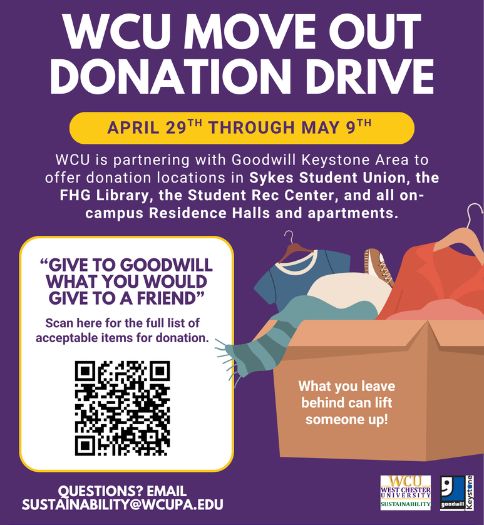
Bins will be set up April 29 through May 11 in Sykes Student Union, the FHG Library, the Student Recreation Center, all on-campus residence halls, and at the University’s apartment complexes. Students are encouraged to donate only usable items — nothing broken — and check Goodwill's list of approved donations. Employees may use the bins in Sykes, FHG Library, and the Student Rec Center to donate usable goods.
The Office of Sustainability was instrumental in brokering this partnership between WCU and Goodwill Keystone Area. Communications and media students in classes with Dr. Maxine Gesualdi and Dr. Megan Schraedley created social media posts to promote the project in both the fall and spring semesters.
Goodwill Keystone Area operates 43 stores in 22 counties in south central and southeastern Pennsylvania, with the exception of Philadelphia and Delaware County. The Goodwill organization creates sustainable communities and builds pathways to self-sufficiency for individuals and families across generations by recycling donations into training, paychecks, careers.
In March, Bruce Brockman, Goodwill Keystone Area’s vice president of sustainability, operations and logistics, presented one of the Office of Sustainability’s Wednesday noon lectures: “The 4 Ps of Sustainability: Prosperity, Planet, People, Perpetuity.” He stated, “Our approach to it is that we minimize the waste through our collections, our reselling, our recycling, and our salvaging. What we want to do is replace the take, make, dispose, and replace it with the reduce, reuse, recycled model.” Among the initiatives Brockman cited: textile recycling partnerships; e-waste recycling programs; community education around reuse and sustainability; and local and national collaboration with recycling innovators.
Brockman’s presentation is available here (50 minutes).
Move Out, Give Back for Off-Campus Students
Students who live off campus within the Borough of West Chester and have gently used furniture to donate can sign up for the Move Out, Give Back program organized by WCU’s Student Experience team. Those donations go to Chester County’s Community Warehouse Project and can include household electronics such as lamps, microwaves, and coffee makers; sofas and other upholstered furniture without rips or stains; tables, chairs, bookcases; and more. Students must sign up for the Move Out, Give Back program in order to donate to the Community Warehouse Project.
And if your personal electronics are kaput, recycle them on campus rather than putting them in the trash. Laptops, wires/cables, mouses, routers, remotes, game consoles are among the items you can drop off at the FHG Library or Sykes for PAR Recycle Works to take away.
Free Shopping at WCU’s New Online Thrift Store
Additionally, a WCU online thrift store is now open and all items are free! The online catalog is the work of senior Honors student Anna Roe, who created a catalog where students can recycle items and place orders at no cost. Donation bins are located in residence halls, FHG Library, and the Office of Sustainability.
Roe, a psychology major, notes, “I took a class with Dr. Paul Morgan last spring called HON 314: Technology and Environmental Systems. In the class, we discussed a lot of environmental issues that I saw no way of personally impacting. However, when textile waste was mentioned, I was struck by much college students are targeted by fast fashion marketing and how significant our environmental impact is in this area. … After talking to some connections with the Resource Pantry, I developed a plan to have an affordable online store to mimic the fast fashion niche. … From there, I applied to a job with the Office of Sustainability and spent this semester bringing the plan to fruition. I am really excited to see how this evolves as a different student takes over this new position next year.”
For more information, contact sustainability@wcupa.edu.