
Mather Lecture Series Welcomes NASA’s Dr. Elizabeth Rampe
 As NASA prepares for this week’s planned launch of the Artemis 2 mission, the first
crewed space flight around the moon in more than 50 years, one NASA scientist will
be at West Chester University with a view toward Mars.
As NASA prepares for this week’s planned launch of the Artemis 2 mission, the first
crewed space flight around the moon in more than 50 years, one NASA scientist will
be at West Chester University with a view toward Mars.
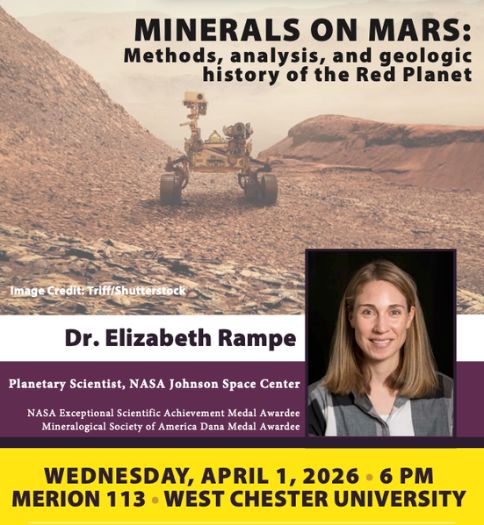
On Wednesday, April 1, Dr. Elizabeth Rampe, a planetary scientist at NASA’s Johnson Space Center, will present “Minerals on Mars: Methods, Analysis, and Geologic History of the Red Planet.” Dr. Rampe studies Mars geology and mineralogy and is the deputy principal investigator of the CheMin instrument on the Mars Science Laboratory Curiosity rover.
The lecture begins at 6 p.m. in Merion Room 113. This third program in the Mather Annual Scholar Lecture series is free and open to the public.
Dr. Rampe is an exploration mission scientist within the Astromaterials Research and Exploration Science (ARES) Division at the Johnson Space Center. The ARES division performs the physical science research at the Johnson Space Center and is curator for all NASA-held extraterrestrial samples.
In her presentation, she will detail how Mars was once much more geologically active than it is today. Minerals in its ancient igneous and sedimentary rocks are the key to understanding the planet’s geologic history. Dr. Rampe will discuss orbital and in-situ mineralogical detections, their implications for Mars’ geological evolution, and future directions for Mars mineralogy.
By studying minerals found on ancient Mars that were formed by water-rock interactions and similar minerals in analog environments on Earth, she helps characterize early martian environments. Her research on the evolution of the early martian surface has implications concerning its past habitability since some minerals are diagnostic of the environments in which they were formed. Researching martian planetary processes and environment is central to data gathering for NASA's future mission to Mars. Dr. Rampe is also interested in the relationship between human mission operations and science. She supports human analog missions and studies the incorporation of science and scientists into extravehicular activities (EVA).
This lecture series, hosted by the Department of Earth and Space Sciences at WCU, is named for Sandra “Sandie” F. Pritchard Mather ’64, M’68. Mather earned a B.S.in elementary education and an M.Ed. in geography from what was then West Chester State College, and her Ph.D. from the University of Oregon. She returned to her alma mater to teach in the West Chester Laboratory School before accepting a position in the Department of Earth and Space Sciences teaching both undergraduate and graduate geology, meteorology, and geomorphology. After retiring in 1999, she was named WCU emerita professor of geology and astronomy. During the University’s Sesquicentennial in 2021-22, she was selected as one of the 150 Most Influential Women of West Chester. A long-time supporter of the University and its students, she is also the namesake of the WCU planetarium.