WCU Museum Opens “Panel by Panel: The Social and Cultural Impact of Comics”
 Although comics are often considered child’s play, they are anything but simple —
and the newest exhibition at the University’s Museum of Anthropology and Archaeology delves into the history and nuances of political cartoons, manga, graphic novels,
and Marvel and DC superheroes.
Although comics are often considered child’s play, they are anything but simple —
and the newest exhibition at the University’s Museum of Anthropology and Archaeology delves into the history and nuances of political cartoons, manga, graphic novels,
and Marvel and DC superheroes.
“Panel by Panel: The Social and Cultural Impact of Comics” runs October 30, 2025, through December 31, 2026, in the Old Library (775 South Church Street). The opening reception is Thursday, October 30, at 6 p.m. Those attending the free reception are encouraged to dress as their favorite cartoon character or superhero.
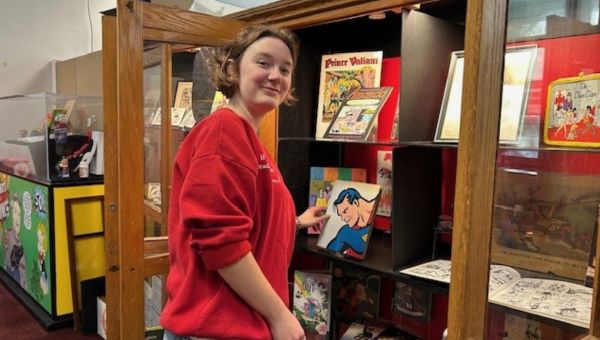
Co-curated by 11 students (two graduate-level and nine undergraduates) under the guidance of Dr. Michael A. Di Giovine, professor of anthropology, the exhibition explores the history, development, and artistic craft of comics; their impact on education, commerce, and collecting culture; and their reflection of society’s treatment of diverse genders, sexualities, races, and religions. As a digestible medium, comics reflect, but simultaneously contest, complex cultural commentaries. They are an accessible form of visual storytelling that creates narratives often through pictures and words, and are used across the world to teach, persuade, rally, and even escape reality.
Greeting visitors is a lenticular wall that presents the history and development of comics, from precursors like cave paintings and illuminated Medieval manuscripts to contemporary superhero comics and graphic novels.
Among the authentic artifacts on display are some of the earliest comics published in the United States by the “father of American political cartoons” Thomas Nast; 19th-century Darktown and Punch comics; French satirical weekly newspaper Chalie Hebdo’s famous Je Sui Charlie issue following the 2015 shooting in which 12 people were killed at their offices; rare cross-over collectibles; stained glass windows; contemporary illustrations by WCU faculty; and even original sketches by Spider-Man creator Steve Ditko.
The youngest museum visitors can try their hand at making their own comics with materials provided in the exhibition. Children can use interactive plastic filters in different colors to change the color of their superhero, encouraging them to think about how changing a character’s appearance and skin color changes their thinking about the character’s abilities or appeal.
“From teaching astronomy, literature, and the complex tenets of Buddhist thought to mobilizing nationalism (and sometimes xenophobia), this exhibition really shows that comics and cartoons have always been a powerful and persuasive medium for getting a message across effectively,” says Dr. Di Giovine.
Sometimes, that message is propaganda. Dr. Di Giovine points out that the curators juxtaposed some of the historical comics that denigrate religions, races, and genders in displays with modern comics that show positive examples, such as Black Panther. Extensive signage details society’s changing treatment of minority populations as illustrated in the comics.
One graphic novel on display represents the power of this medium. The work is about a young man who became known as the “patron saint of the internet,” the late Carlo Acutis. The graphic novel, as well as others, was integral in spreading his devotion among younger generations of Catholics, leading to Acutis’ canonization in September by Pope Leo.
WCU Anthropology Museum exhibitions are an exercise in cross-disciplinary collaboration. Dr. Di Giovine co-curated and co-taught the class with Tom Haughey, associate professor of theatre and dance. History graduate student Grace Welsh is the graduate assistant curator. Maria Monachino, WCU scenery workshop coordinator, painted the comics on the exhibit cases, and WCU graphic designer Stephanie Thompson designed the labels and other graphics in comic-book style.
External partners provided some materials while others came from WCU connections. Dr. Ashley Patriarca, WCU associate professor of English, loaning Peanuts collectibles and facilitated the loan of artifacts from the English Department’s 1,000+ comic book collection, donated by English Professor Dr. Gabrielle Halko’s family. Additional loaned works came from anthropology and museum studies student Grace Carson’s family collection of more than 3,000 comics.
Jeremy Holmes, award-winning illustrator and associate professor of Art + Design, contributed illustrations and Fulbright grantee Dr. Alessandra Seggi, adjunct professor of sociology, shared sketches for her graphic novel that teaches sociological research methods.
The University Libraries’ Special Collections loaned cartoons from the student newspaper Quad Angles (the predecessor of the current Quad newspaper). Cartoonist Robert Mitchell Landis, who matriculated to West Chester State Teachers College in 1948 after World War II, frequently chronicled the daily challenges facing the young men and women at the college in a humorous way in his work.
Also on exhibit from the late Dr. George F. Reed, WCU emeritus professor of astronomy’s: his “Comic Startoons” poster, an illustration of the constellations as comics that is featured in planetaria around the world, including the National Space Centre in Leicester, England.
Italian artist-ceramicist Valeria Vestrelli was specially commissioned to create an original artwork for the exhibition. “Il Futuro” (The Future) is a cartoon painted on a ceramic tile that represents both nostalgia for the past and the uncertainty and fear of the future.
“Panel by Panel: The Social and Cultural Impact of Comics” runs October 30, 2025, through December 31, 2026. Admission is free. The Old Library is located at 775 South Church Street in West Chester (19383). For more information or to schedule a visit, please email the Museum or call 610-436-2247.