West Chester University a Trusted Resource for Budding Engineers in first® LEGO® league competition
West Chester University (WCU) has opened its doors, and its Museum of Anthropology and Archaeology, to a wave of middle school students this fall as more than 20 FIRST® LEGO® League Challenge teams prepare for this year’s international robotics competition. This year’s competition theme is “Unearthed” and focuses on archaeology. Students in grades 5-8 are being asked to design robotic solutions to real-world problems archaeologists face.
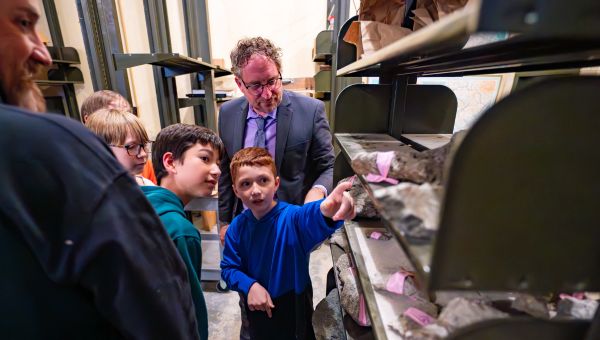
“We never expected the museum to become a go-to resource for robotics teams, but that’s exactly what happened,” said Michael A. Di Giovine, WCU professor and director of WCU’s museum. “Because of this year’s theme, the museum has been getting lots of inquiries from LEGO® teams to meet our archaeologists and archaeology students.”
FIRST® (For Inspiration and Recognition of Science and Technology), founded in 1989, is a global nonprofit that uses robotics to promote STEM learning. Its LEGO® League Challenge introduces students to coding, engineering, and design thinking through team-based competition.
With archaeology in mind, more than 20 teams from across the region (Downingtown, Chester Springs, Unionville, Chadds Ford, even New Jersey and California) have found their way to WCU’s anthropology museum, either in person or via Zoom. The University’s students and faculty have offered interactive exhibits, artifact-handling sessions, and insights into how real archaeologists conduct field and lab work.
“We take them on a tour of the museum to talk about artifacts, then go to the lab where our students give a kid-friendly presentation on what archaeology is,” Di Giovine said. “There’s usually a pretty involved Q&A session before we do a hands-on activity with 5,000-year-old artifacts.”
Barbara Silber, WCU adjunct professor and a professional archaeologist with 40 years of experience, said the robotics questions have been unexpectedly eye-opening.
“The students ask a lot of questions about what challenges we face and how robots might help,” she said. “It’s something I haven’t thought about too much before. It’s made me think: What actual tasks could you get a robot to do without losing that hands-on feeling that’s vital to the archaeology process?”
WCU senior Peyton Miller, an anthropology major from Downingtown, has been instrumental in delivering the museum’s outreach. She created a presentation that walks students through the stages of archaeological research, from excavation to preservation.
“It seems to be a pretty helpful resource for them. I’ve had several groups ask me to send it to them,” she said. “My favorite groups have been the larger ones. Once we had six teams in one room. Everyone was going in a different direction with their questions. It was super interesting to see.”
The sessions have helped the LEGO® students, and even their coaches, refine their understanding of archaeology.
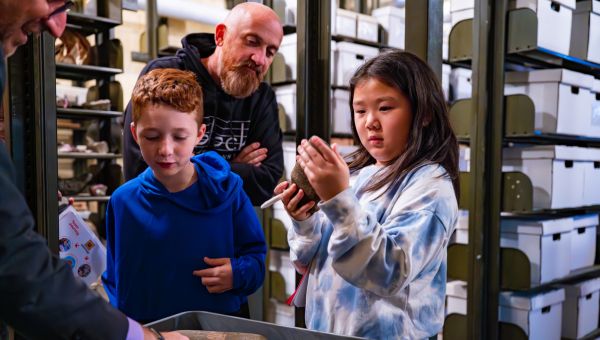 Bo Li, a Villanova associate professor and coach of a local team, the “Artifact Alliance,”
said he was surprised that he learned as much about archaeology as his son, Ethan,
who is on the team.
Bo Li, a Villanova associate professor and coach of a local team, the “Artifact Alliance,”
said he was surprised that he learned as much about archaeology as his son, Ethan,
who is on the team.
“Initially, I thought you were just trying to dig out of the ground,” he said. “But I realize now that there’s a careful methodology. The treasure is the knowledge itself, not just the artifact. That’s really inspiring for the kids.”
Li also said he was thankful to WCU for its warm welcome.
“We’ve contacted professors all over the country, and this is the best reaction we’ve had,” he said. “I really appreciate what West Chester University is doing.”
With regional competitions around the corner, the LEGO® teams are busy refining their projects and finalizing their robot designs. For WCU, the real win is already clear.
“We’re hopeful some of the teams will go far in the competition,” Di Giovine said. “Maybe we’ll do an exhibit with the robots they create.”
For more information on WCU’s Museum of Anthropology and Archaeology, please write museum@wcupa.edu or visit their website at www.wcupa.edu/museum.