
Attention Incoming first-year students:
Incoming first year students: Your classes will be scheduled for you by WCU faculty and staff for your first semester. To help us build the best schedule for you, you'll complete the First-Year Journey.
What is the First-Year Placement Journey? The First-Year Journey is a set of placement exams, surveys, and modules that help your academic department create a schedule aligned with your academic interests and program.
Completing your First-Year Journey
The sooner you complete the First-Year Journey, the sooner you’ll receive your class
schedule. Having your class schedule before New Student Orientation is ideal so you
can explore class locations and meet classmates.
A RamNet ID account is required to access and complete your First-Year Journey. Learn
how to set up your @wcupa.edu account
Completing the First-Year Journey is required for all first-year students.
Surveys and questions are unique to each student, so students will get different components
depending on their declared major.
Please plan to complete the Journey in one sitting. The Journey takes 30 minutes
- 2 hours to complete.
You will need to complete the First-Year Journey on a computer or laptop computer
with access to a camera.
How to Access your First-Year Journey
- Log into Navigate on a laptop or desktop computer using your RamNet ID login.
- Locate the "Journeys" button on the left-hand side of your screen.
- See step-by-step instructions in this Guide to Completing & Viewing First-Year Journey
To learn more about the First-Year Journey, Class Schedules, Changing your Major, Adjusting your Class Schedule, or adding a minor - click on this link!
Advisor/Advisee Information
Who is my advisor and when will they be assigned?
Your advisor's name appears on your RamPortal In addition to your faculty advisor, you can also consult with your College Student Success Coordinator. Make appointments to ask them about scheduling, policies, and campus resources.
How and when do I schedule an appointment with my advisor?
Contact your advisor through his/her preferred method. Some ask you to email them; some use online appointment software; some request that you sign up on a sign-up sheet at their office. If they don't tell you, just ask! Here is a weekly timeline you can follow to help know when is the right time to start thinking about making a plan for the next semester.
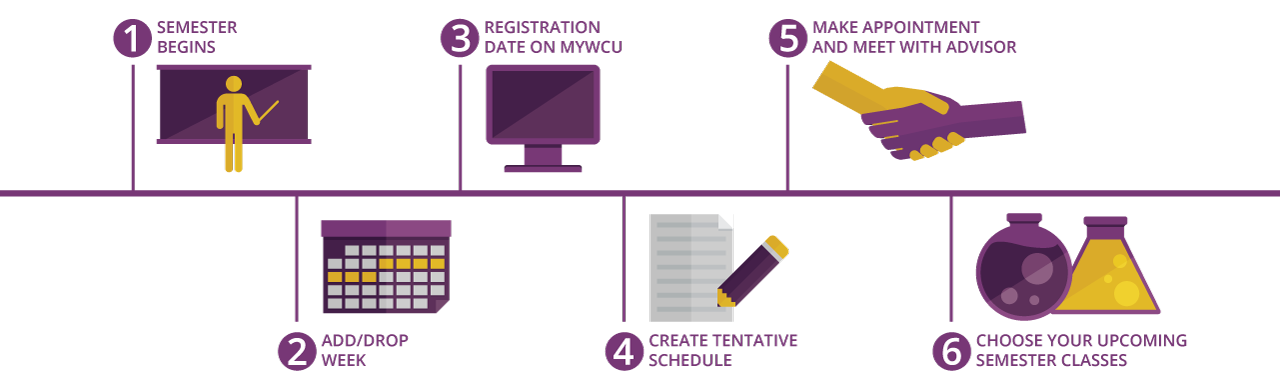
- Semester begins.
- Drop/Add week.
- You may drop or add classes within the first week of the semester. Check the Academic Calendar to learn the dates for the current semester's drop-add.
- Your individual enrollment date for the next semester appears on your Ramportal homepage.
- Create a tentative schedule in Ramportal one to two weeks before your upcoming enrollment date. Many advisors will not meet with you until this is complete.
- Make an appointment to meet with your advisor one to two weeks before registration.
- Meet with your advisor. Your advisor lifts the advising hold.
- On your registration date, you can choose your classes.
- Check your registration date in your Ramportal account.
- You may change your schedule through the end of the next semesters drop add week.
Advising Expectations
Academic advising is an educational partnership between a faculty member and a student whose goal is the students’ academic, personal, and professional success. Advisors and advisees collaborate to help students achieve their aims. Advisors explain policies, identify resources, and give advice; however, students are ultimately responsible for making the decisions that will keep them on track. The advising relationship thus mirrors other teaching relationships at West Chester University.
-
- At WCU, advisors and advisees: (Good Advising: A Shared Responsibility Chart)
- Treat each other with respect
- Understand their advising duties
- Work to clarify students' professional and life goals
- Contribute to realistic academic and career plans
- Educate themselves about institutional policies, procedures, and opportunities
- Contribute to making good class choices
- Address challenges through knowledge and use of campus resources
- Use available technological tool
General Education and Major Related Information
What is my four-year plan for my major?
Looking for advising materials for your major? Check out our comprehensive list. You’ll be directed to department websites where you may find a four-year plan, advising guide, or handbook. You will also find links to the academic catalog for each major.
How do I switch my major before starting my first year or after that?
- If you are an incoming first-year student, please contact the Undergraduate Admission’s Office to see if you can change into your desired major. If you are unable to switch, you can request to enter Exploratory Studies (EXPS). EXPS will assist you in finding the right path and help you to meet the entrance requirement for your intended major.
- First, discuss your plans with your current advisor. Consider any additional requirements and time will be involved in changing your major. You can meet with or transfer to a special program in Exploratory Studies that will allow you to work on meeting any entrance requirements for your new major. Once you decide to change your major, you can request a change of major through your Ramportal account. Click on Academic Records and then select Request a Plan Change.
What are the differences between general education, major and related courses?
- General Education: The liberal arts portion of your degree ensures that you have some exposure to the arts, humanities, social/behavioral sciences, and natural/computer sciences. This is part of becoming an informed citizen, with a broad understanding of different disciplines.
- Major Courses: Each major includes specific courses for students to complete that are specific for that major.
- Related Courses: Some majors may have you complete courses that are not taught within the department of the major, but will request you to complete courses that are related to the overall career field by taking courses within different departments.
Grade Types and Calculations
- Check out the Registrar’s website to learn more about grade types and what they mean!
- Do you want to calculate your GPA? Enter your previous grades earned and predict future grades to see how the current grades will impact your cumulative GPA.
Title IX
- Students and advisors can help those who believe they may have been victimized sexually or have been accused of sexual misconduct by consulting these Sexual Misconduct resources. Students should know that all faculty must report to the Office of Equal Opportunity and Compliance any incidents of sexual misconduct (unless they were noted during a classroom discussion, in a writing assignment for a class, or as part of a University-approved research project). If students do not want this information reported under the student’s name, s/he can speak to employees with confidential exemption:
- Counseling Center
- Student Health Services
- You can also report via a confidential online form