CESW Hosts Inaugural Conference on Healing-Centered Engagement & Trauma-Informed Education
More than 40 WCU students had the opportunity to attend and others to volunteer.
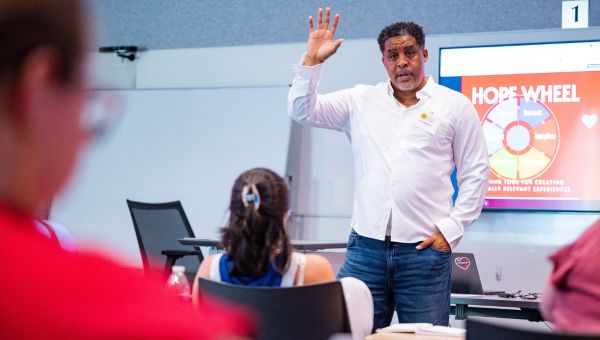 WCU was the site for the first Healing-Centered Engagement & Trauma-Informed Education Conference hosted by the College of Education and Social Work (CESW) on August 13. Nearly 150
attendees took part in presentations, workshops, and panel discussions reflecting
diverse perspectives and practices, including research-based insights, practical strategies,
and interactive experiences. Woven between traditional sessions were well-being activities such as yoga, meditation and mindfulness, which supported the emotional and physical health of attendees.
WCU was the site for the first Healing-Centered Engagement & Trauma-Informed Education Conference hosted by the College of Education and Social Work (CESW) on August 13. Nearly 150
attendees took part in presentations, workshops, and panel discussions reflecting
diverse perspectives and practices, including research-based insights, practical strategies,
and interactive experiences. Woven between traditional sessions were well-being activities such as yoga, meditation and mindfulness, which supported the emotional and physical health of attendees.
The event served not only professionals, educators, and students but also the greater community, shining a spotlight on the movement toward healing-centered education and care that uplifts individuals and strengthens communities. The movement shifts from focusing solely on trauma to emphasizing healing-centered engagement, an approach that honors the whole person and prioritizes community care, empowerment, and holistic well-being.
“This conference is unique as we focused on topics in education, social work, and counseling that are truly timely and needed,” said Dr. Alyssa Blasko, assistant professor of special education. “With this interdisciplinary approach in mind, we strived to educate our University students as well as current practitioners on innovative, strength-based, and culturally responsive approaches to trauma-informed education.”
More than 40 WCU students had the opportunity to attend and others to volunteer. Taking part in the sessions brought them new understanding and gave them confidence.
Amanda Hopkins is an advanced standing MSW student at the Philadelphia campus on track to graduate in May 2027. She volunteered at the conference to monitor sessions and introduce presenters, noting, “I was particularly struck by ‘From Harm to Hope: Healing-Centered Approaches for Strengths and Holistic Well-Being.’ I found the presentation to offer a great foundational understanding of the transition from trauma-informed to healing-centered practices. Something I thought about is how many of us in these professions measure our own growth and healing through our academic and professional accomplishments.
“I think we’re all familiar with the ‘wounded healer’ concept in helping professions,” Hopkins continued. “The presentation made me think about how we as professionals could move from seeing ourselves this way to seeing ourselves as healing healers, healed healers, growing healers, etc. That transition would make us more balanced practitioners, who are able to apply the same perspective to our clients.”
Don Altemus, who volunteered as a session monitor, said he got the most out of the breakout session on supporting clinicians and clients after a critical incident. An MSW student and academic coach/graduate assistant in WCU’s Office of Educational Accessibility (OEA), he said, “This session was especially close to the work I am doing right now and is something I was seeking more information about even before the conference. I will be using the Healing Centered Action Plan as a tool for my own wellness. My big takeaway was the importance of our own self-care, whether that is after a critical incident or just the everyday stress of the work we do.”
A senior majoring in social work, Milos Djurdjevic volunteered as a breakout session monitor, noting, “Alonya Chest from the session ‘Lipstick and Lecture Halls: Drag Artistry Across Academia’ resonated the most with me. They discussed drag shows as avenues for increasing the audience’s comfort and confidence in their ability to express whatever gender they choose. They also described these shows as tools for increasing the sense of belonging among college students. … I especially appreciate how Chest connected the utility of drag shows with empowering neurodivergent folks like myself.”
From the session, Djurdjevic realized, “It really doesn’t take that much effort to help others feel included in spaces that are otherwise operated and exist in ways that only serve dominant groups and exclusively help them feel comfortable.”
The conference raised money to create a fund for students to have increased access to experiential learning, including funds for study-away experiences and to attend conferences.
Including the WCU College of Education and Social Work, conference sponsors were:
- Presenting Healing Sponsor: Friends of Education
- Mentor Sponsors: 240 Tutoring, Lance Bogash '74, Exxat, The Lumina Institute
For current and future sponsorship opportunities, contact Viviann Schorle, WCU Foundation director of corporation and foundation relations: 610-430-4157 or vschorle@wcufoundation.org.
More information on this year’s and future conferences is available here.